
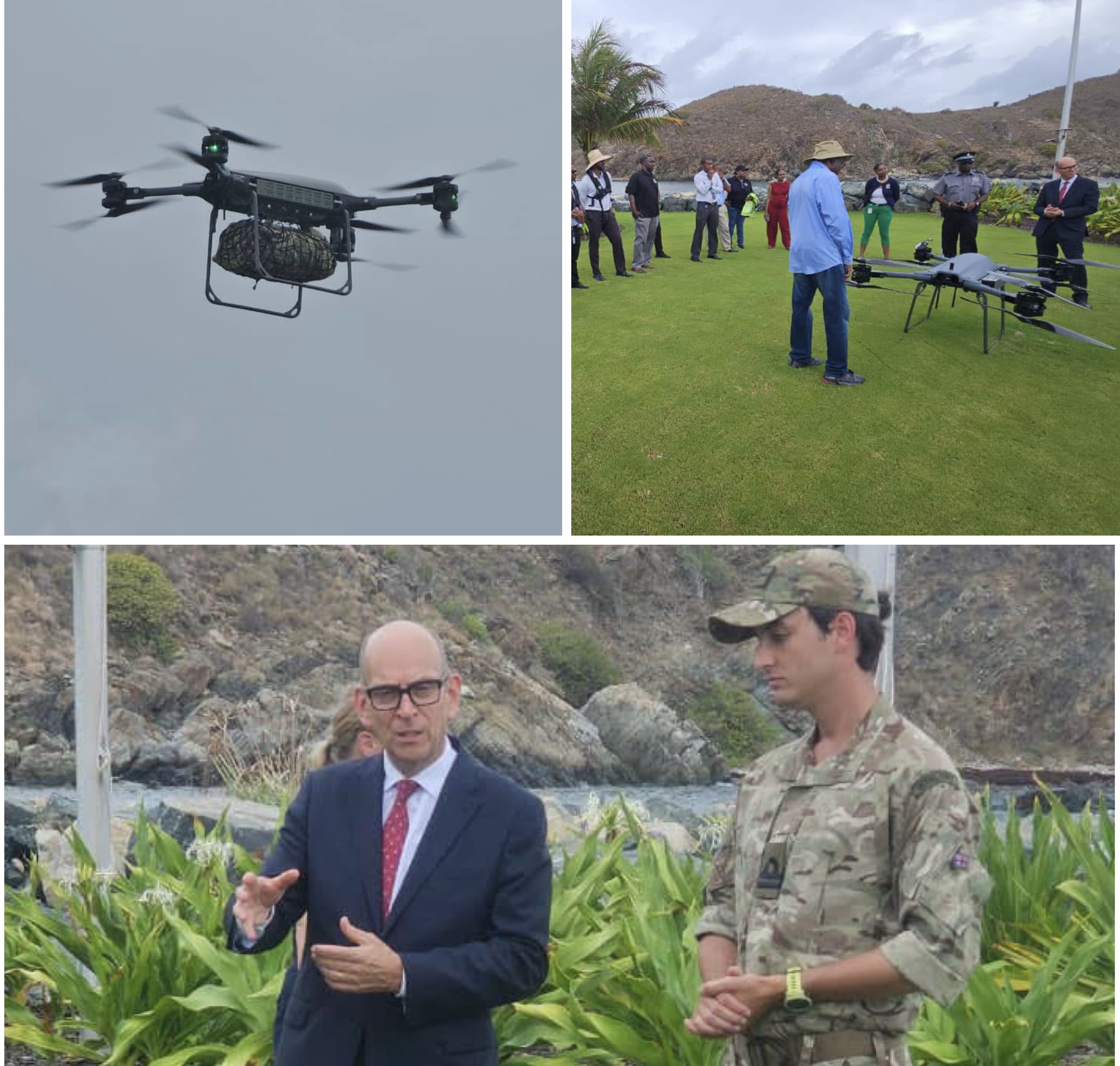
First responders across the Virgin Islands joined officers from the Royal Navy’s HMS Trent on Monday to test an uncrewed aircraft capable of delivering supplies to areas that could become inaccessible following a major disaster.
According to the Department of Disaster Management (DDM), the Malloy T-150B uncrewed aerial system can carry up to 150 pounds, fly for approximately 40 minutes and reach speeds of up to 60 miles per hour. It is also equipped with imaging systems.
The aircraft’s ability to deliver supplies between islands was tested, with a successful drop conducted from Peter Island to nearby Dead Chest.
“Monday’s test was a successful demonstration of how uncrewed aircraft like the Malloy drone can rapidly reach remote locations that might not be accessible at all by land vehicles,” Director of Disaster Management Jasen Penn said.
Penn noted that the ability to receive supplies by air could save lives following a serious disaster that damages the Territory’s transportation network.
HMS Trent Commander Gavin Lowe said aviation specialists had launched the Malloy T-150B from the vessel’s deck for the first time just two weeks earlier.
Governor Daniel Pruce formally welcomed Lowe and the HMS Trent crew to the Territory on Monday morning, describing the visit as part of the Royal Navy’s regular regional deployment during the hurricane season.
According to the DDM, members of the HMS Trent crew specialising in areas including medicine, logistics and humanitarian aid and disaster relief also joined local emergency operations officers for a tabletop exercise focused on major hurricane response procedures.
“Discussion based exercises enhance our understanding of the ship’s capabilities and limits, and give the military teams insight into the Virgin Islands terrain and operational context,” Penn said.
During the exercise, local first responders shared experiences from Hurricane Irma and Tropical Storm Ernesto, while the HMS Trent crew shared lessons from its deployment in Falmouth, Jamaica, following Hurricane Beryl
According to the Department of Disaster Management (DDM), the Malloy T-150B uncrewed aerial system can carry up to 150 pounds, fly for approximately 40 minutes and reach speeds of up to 60 miles per hour. It is also equipped with imaging systems.
The aircraft’s ability to deliver supplies between islands was tested, with a successful drop conducted from Peter Island to nearby Dead Chest.
“Monday’s test was a successful demonstration of how uncrewed aircraft like the Malloy drone can rapidly reach remote locations that might not be accessible at all by land vehicles,” Director of Disaster Management Jasen Penn said.
Penn noted that the ability to receive supplies by air could save lives following a serious disaster that damages the Territory’s transportation network.
HMS Trent Commander Gavin Lowe said aviation specialists had launched the Malloy T-150B from the vessel’s deck for the first time just two weeks earlier.
Governor Daniel Pruce formally welcomed Lowe and the HMS Trent crew to the Territory on Monday morning, describing the visit as part of the Royal Navy’s regular regional deployment during the hurricane season.
According to the DDM, members of the HMS Trent crew specialising in areas including medicine, logistics and humanitarian aid and disaster relief also joined local emergency operations officers for a tabletop exercise focused on major hurricane response procedures.
“Discussion based exercises enhance our understanding of the ship’s capabilities and limits, and give the military teams insight into the Virgin Islands terrain and operational context,” Penn said.
During the exercise, local first responders shared experiences from Hurricane Irma and Tropical Storm Ernesto, while the HMS Trent crew shared lessons from its deployment in Falmouth, Jamaica, following Hurricane Beryl



Community
Comments
What are your thoughts on this story? Share a respectful comment with the community.
Join the conversation
Your comment will appear after review. Email is only needed if you want reply or conversation notifications.